


Printing Photographs Changes Everything

I spend a ridiculous amount of time looking at photographs on screens.
I take them on a screen, edit them on a screen, share them on a screen and, increasingly, archive them on yet another screen.
Then I printed one.
And it felt completely different.
Printing photographs: From screen to paper
Printing photographs isn’t new to me, obviously. Like most people of a certain age, I remember when getting photographs printed was simply what you did. You finished a film, sent it away and waited to discover whether you’d captured something wonderful or twelve photographs of somebody’s thumb.
Digital photography changed that.
Now I can take hundreds of photographs, edit them, zoom into them, change my mind, change it back again and publish the finished image without it ever becoming a physical object.
Half Past Normal has largely existed that way too.
Until recently.
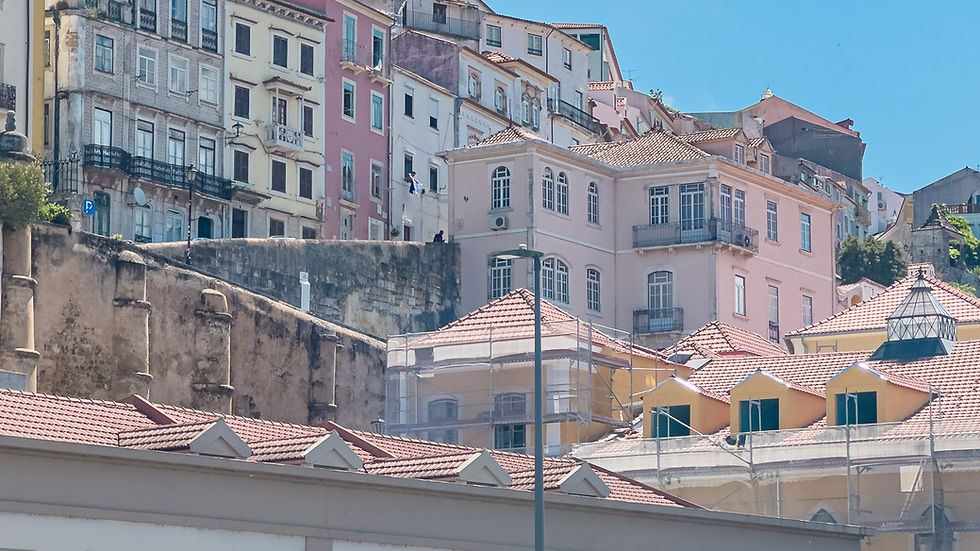
I’d been thinking about putting some of my photographs on the wall, so I chose Layers of Coimbra and Windmills Above the Dry Fields as the first two test prints.
Nothing particularly grand. Just my printer, some glossy A4 photo paper and an idea of how I wanted them to look.
I gave the photographs plenty of white space, added their titles underneath in Cormorant and printed them.
And then I just stood there looking at them.
You see something different
A photograph on paper asks you to look at it differently.
There’s no zooming in. No swiping to the next image. No likes, comments or statistics sitting somewhere nearby telling you whether anybody else thinks it’s good.
There’s just the photograph.
I expected printing to expose problems. If anything, I thought I’d immediately start spotting things I wanted to change.
Instead, I noticed things I liked.
The layers in Coimbra felt more deliberate. The dry landscape around the windmills had room to breathe. Details I’d spent far too long staring at in Lightroom stopped feeling like editing decisions and simply became part of the photograph.
Perhaps most surprisingly, they actually looked like photographs.
That sounds ridiculous, but there is a difference.
On a screen they are files. Images. Content, if we must use that horrible word.
On paper, they became something I had made.
Bigger isn’t necessarily better
I’d assumed that if I ever printed my work properly, bigger would automatically be better.
I’m not so sure now.
These first prints are relatively small. The photographs themselves sit within an A4 sheet with a generous border, roughly giving me the sort of image size you might expect from an 8 × 10 print.
And I really like them that way.
They feel intimate.
You have to actually look at them rather than have them announce themselves from the other side of the room.
That feels much more Half Past Normal.
Quiet observations were never supposed to shout.
The edit has to survive the paper
Printing has also made me think differently about editing.
Recently I’ve been allowing myself to push some photographs further than I used to. I still don't want everything hyper-sharp, over-saturated or processed until it barely resembles what I saw, but I'm becoming less frightened of making an actual decision.
Sometimes +47 is better than +20.
The print is another test of that decision.
A photograph can look fantastic glowing from a bright display and completely different once the light is coming onto it rather than through it.
Shadows behave differently. Colours feel different. Small adjustments suddenly become more obvious — or, sometimes, much less important than they seemed while I was obsessing over them at 200%.
It’s another version of the photograph.
And I think that’s useful.

Making something tangible
There’s another reason I like this.
Half Past Normal began as somewhere to put photographs that might otherwise disappear into an enormous camera roll.
Then came the archive. The website. Collections. Social accounts. Competitions. All the slightly ridiculous organisation that has grown around what began as me noticing things and taking pictures of them.
Printing feels like the opposite of all that infrastructure.
It’s wonderfully simple.
A photograph. A piece of paper. A frame.
No algorithm needs to see it. Nobody needs to click on it. It doesn’t need five hashtags or a caption or the correct aspect ratio for whatever platform has changed its mind this week.
It can just exist.
What happens next?
I’ve already started thinking about which photographs should join the first two.
Not necessarily the most popular ones.
Not necessarily the technically strongest ones either.
I want the photographs that I’d be happy to walk past every day and still occasionally stop to look at.
That might turn out to be another useful test for Half Past Normal.
Because perhaps the question isn’t always whether a photograph is good enough to post.
Maybe sometimes it’s simply:
Would I put it on my wall?
And now, for the first time in a long while, I’m actually finding out.


Comments